
MaMa-CRM arc42 section 8
Cross-cutting Concepts
8.1 Generated Persistence based upon Domain Model
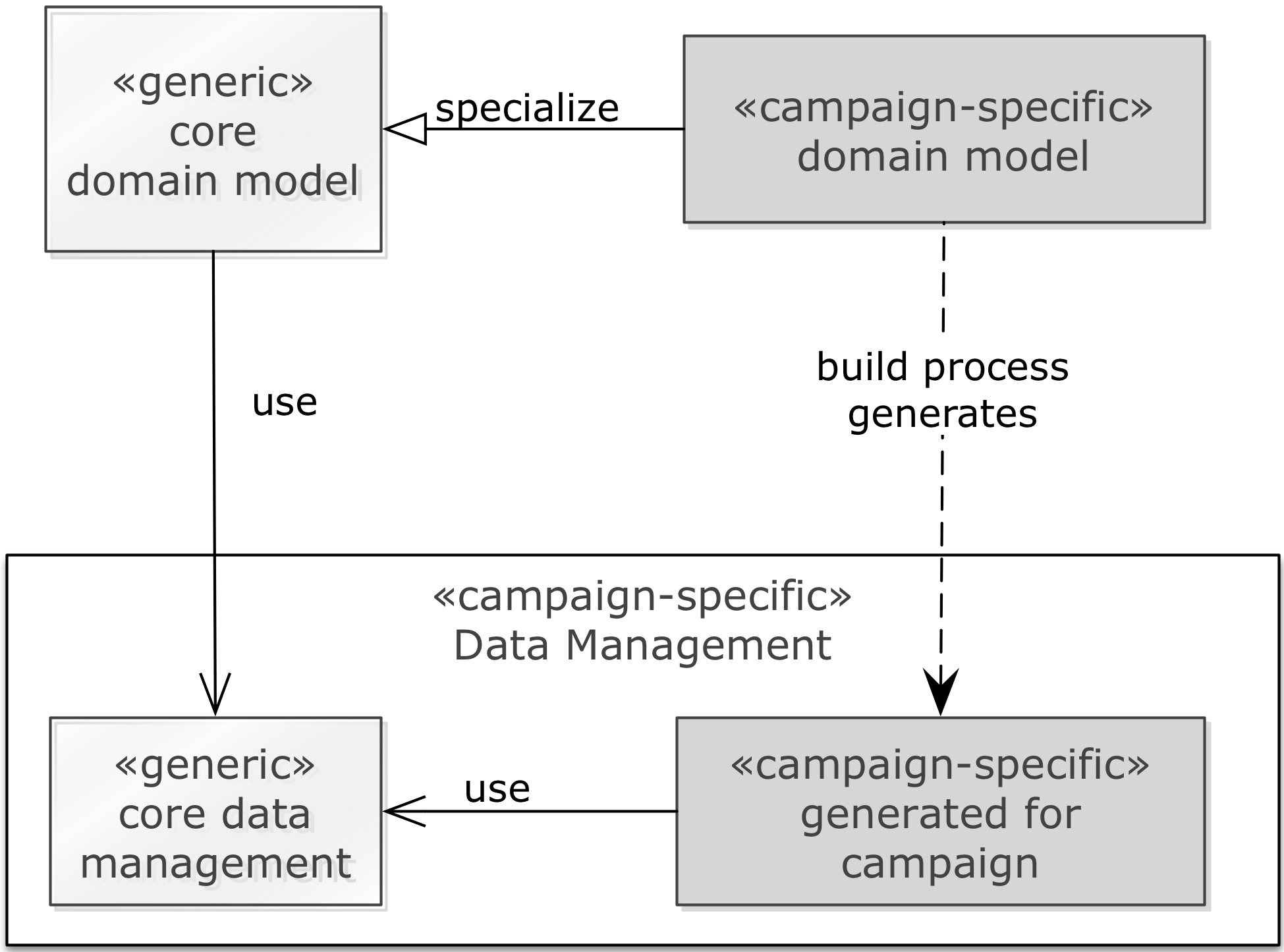
MaMa uses a code generator to generate all (!!) required persistence code from a UML entity model. The overall concept of this generation is depicted in the following diagram. Generic and campaign-specific parts are stereotyped in this diagram. The «campaign-specific» Data Management component is automatically created and packaged by the build process.
| Element | Applicability | Description |
|---|---|---|
| Core Domain Model | «generic» | UML model containing the generic classes and relations every MaMa instance needs. |
| Core Domain Data Management | «campaign-specific» | Handwritten code, some Hibernate stuff, some generic finder and repository methods. |
| Specific Domain Model | «campaign-specific» | UML model enhancing the Core Domain Model. |
| Data Management | «campaign-specific» | Java jar archive generated by the code generator specifically for a campaign. Name and ID of campaign is contained in metadata, so different instances of this element are distinguishable, e.g. for audit or revision purposes. |
| Code Generator | «generic» | not shown in diagram. |
This concept relies on the following prerequisites:
Prerequisites:
- Every MaMa instance will handle data related to individual people - called clients in MaMa domain terminology.
- All clients will have a small number of common attributes.
-
For all productive campaigns MaMa needs to handle an arbitrary number of additional attributes.
- Every mandator will add several campaign-specific attributes to the client, and/or will add campaign specific types (like insurance-contract or mobile-phone-contract)
- Once configured prior to campaign start, these campaign specific data structures will rarely change1
8.1.1 Generic Domain Model (“MaMa-Core-Domain”)
| Element | Description |
|---|---|
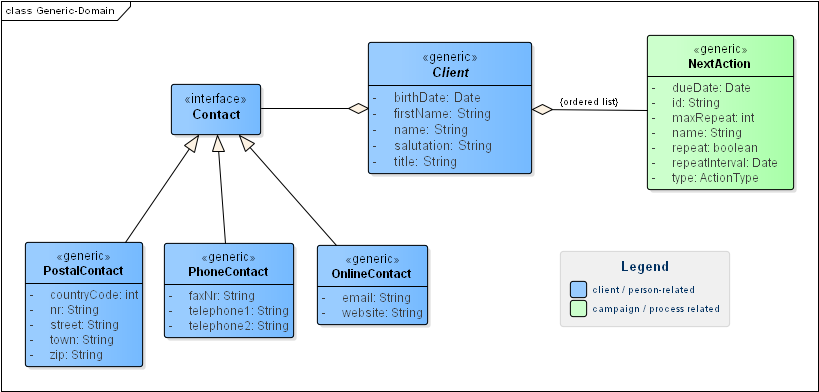
| Client | Abstract class, representing a person plus corresponding contact information. |
| Contact | Contact information that will be used for contacting the client instances during campaign execution. |
| Next Action | Generic class describing campaign activities. Central to the concept of campaign process control and business rule execution |
8.1.2 Example for a Campaign Specific Domain Model
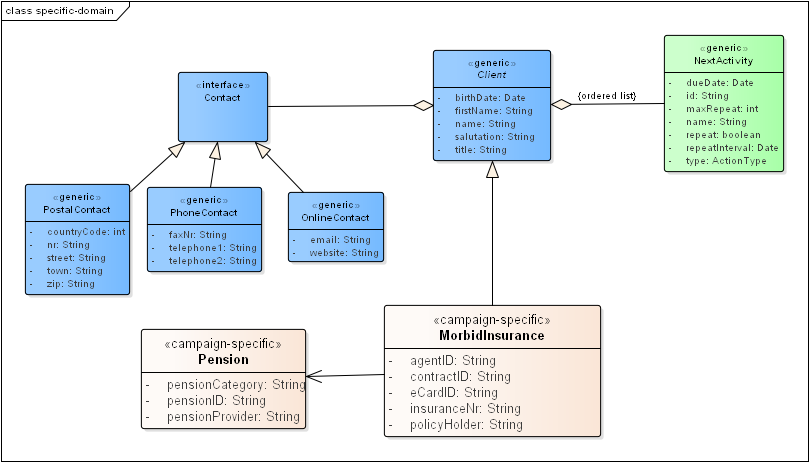
Specific campaign models always contain a (physical) copy of the complete core domain. The abstract Client class always need to be subclassed, and might be 1:n associated with additional classes.
8.1.3 Generator Details
- MaMa uses OpenArchitectureWare to generate the complete persistence code.
- Generation relies on the open source Hibernate O/R mapping and persistence framework.
- The generator generated the following elements:
- DDL code to create database, schema, tables and indices.
- Hibernate mapping files
- Campaign specific implementations of
findClientByXY,findNextActivityand similar methods - A number of campaign- and configuration specific methods for reporting and monitoring
- m:n associations are not supported
- modifications of data structures are not possible when campaigns are already active.
Due to nondisclosure agreements with InDAC we cannot show example source code for the persistence concept.
Alternatives
- Initially MaMa had started with AndroMDA code generation framework, but that open source project lost popularity, could not deliver the required support and ceased working with newer Maven releases - so MaMa switched to OAW.
- MaMa uses the commercial MagicDraw UML (in version 9.0) modeling tool, which can in principle generate code based upon models, but proved to be too inflexible for the desired Hibernate integration. The contracting entity (InDAC) refused to upgrade to newer versions or alternative tools.
8.2 CSV Import / Export
- TODO: Describe (some) details of the CSV configuration DSL
- TODO: Describe (customized) Eclipse editor for these DSLs
8.3 Configurable File Filters
As explained in the runtime scenario “import raw”, every file read during import from an external source needs to be transformed via configurable filters. We most often have two kinds of filters, encryption and compression.
The names and required parameter settings for every filter is managed as part of the activity configuration within a campaign.
Encryption filters
Encryption filters are compliant to the Java Cryptography Architecture (JCA), interfaces.
We urge mandators and partners to use crypto providers from the BouncyCastle portfolio. Encryption and decryption filters need credentials or certificates as part of their configuration.
Due to the sensitive nature of data handled by the original MaMa system the owner required strict nondisclosure in that aspect. Therefore we are not allowed to go into any detail of security.
Compression filter
MaMa supports only losless compression algorithms, Compression can be configured to be either DEFLATE (as used in zip or gzip) or varieties of Lempel-Ziv compression. Compression filters have no parameters.
8.4 Rule Engine for Process and Flow Control
8.4.1 Flow of Action
8.4.2 Drools as Rule Engine
MaMa uses the open source rule engine Drools for definition, implementation and execution of business rules. Rules are defined as text files, which is interpreted at runtime by the rule engine. This enables modification and maintenance of rules without recompilation and redeployment of the whole system.
On the other hand, faulty rules can seriously hamper an active campaign – therefore modification of business rules shall always be thoroughly tested!
Rules always have a simple “when <A> then <B>” format, where <A> and <B> are Java expressions.
You find a complete reference and many examples of the rule language at Drools documentation home.
-
In several years of MaMa operation, data structures within an active campaign always remained fix, therefore MaMa did never need any data migration utilities… ↩