
HtmlSanityCheck arc42 section 3
Context and Scope
Content and Motivation
You want to know the boundaries and scope of the system to distinguish it from neighboring systems. The context identifies the systems relevant external interfaces.
3.1 Business Context
You want to identify all neighboring systems and the different kinds of (business) data or events that are exchanged between your system and its neighbors.
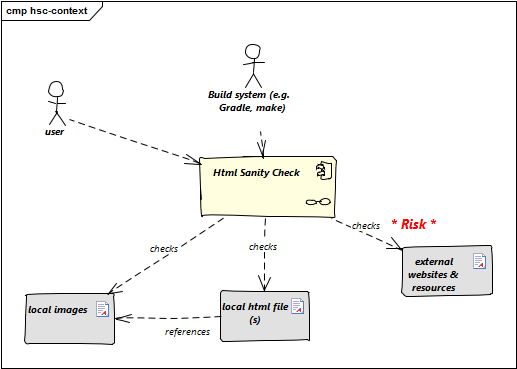
| Neighbor | Description |
|---|---|
| user | documents software with toolchain that generates html. Wants to ensure that links within this HTML are valid. |
| build system | mostly Gradle |
| local HTML files | HtmlSC reads and parses local HTML files and performs sanity checks within those. |
| local image files | HtmlSC checks if linked images exist as (local) files. |
| external web resources | HtmlSC can be configured to optionally check for the existence of external web resources. Risk: Due to the nature of web systems and the involved remote network operations, this check might need significant time and might yield invalid results due to network and latency issues. |
3.2 Deployment Context
You like to know about the technical or physical infrastucture of your system, together with physical channels or protocols.
The following diagram shows the participating computers (nodes) with their technical connections plus the major artifacts of HtmlSC, the hsc-plugin-binary.
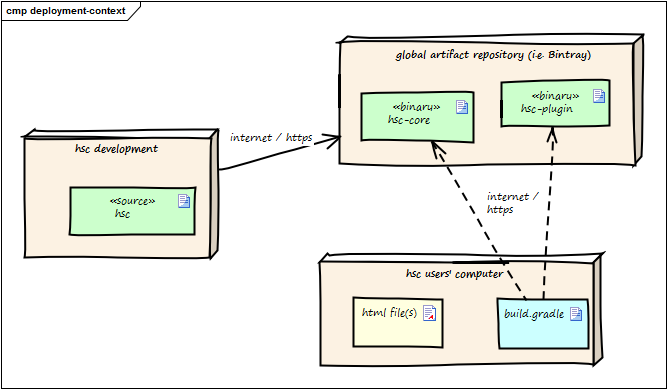
| Node / Artifact | Description |
|---|---|
| hsc-development | where development of HtmlSC takes place |
| hsc-plugin-binary | compiled and packaged version of HtmlSC including required dependencies. |
| artifact repository | A global public cloud repository for binary artifacts, similar to MavenCentral, the Gradle Plugin Portal or similar. HtmlSC binaries are uploaded to this server. |
| hsc user computer | where arbitrary documentation takes place with html as output formats. |
| build.gradle | Gradle build script configuring (among other things) the HtmlSC plugin to perform the HTML checking. |
For details see the deployment-view.